

We build Billdr. Timeline details are sourced directly from CoConstruct's official migration page (coconstruct.com/migration) as of July 2026. Buildertrend does not publish pricing; the Annual Project Volume (APV) figures cited here come from independent 2026 industry reviews, not Buildertrend's own rate sheet. Confirm current pricing directly with Buildertrend before deciding. Billdr Core OS pricing is published at billdr.ai.
The CoConstruct Wind-Down Timeline
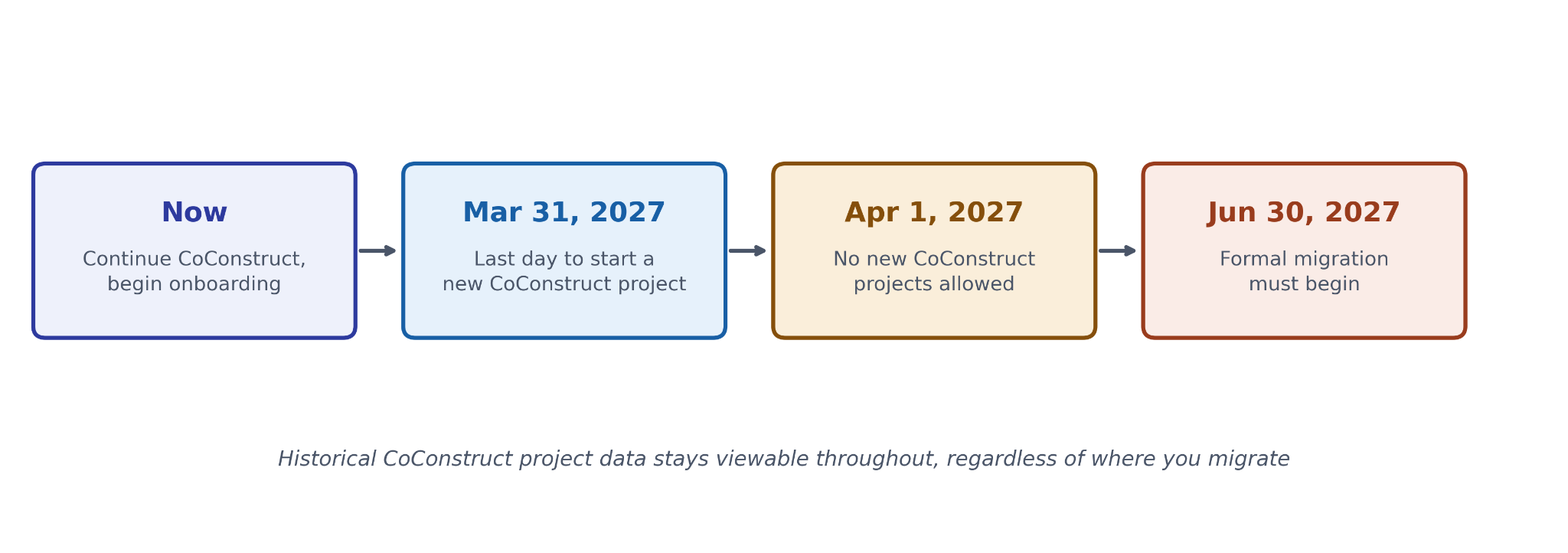
The CoConstruct-to-Buildertrend migration timeline, straight from CoConstruct's own migration page.
| Milestone | Date | What it means for you |
|---|---|---|
| Months 1-3 | Now through early migration window | Continue running active CoConstruct projects while onboarding onto Buildertrend begins in parallel |
| New projects allowed | Through March 31, 2027 | Last date you can start a brand new project inside CoConstruct |
| New projects blocked | April 1, 2027 | No new CoConstruct projects can be created after this date |
| Formal migration begins | By June 30, 2027 | Buildertrend's migration notices require formal transition to have started |
| Historical data | Ongoing | CoConstruct remains viewable for historical project reference either way, regardless of where you migrate |
Why the Buildertrend Path Won't Fit Everyone the Same Way
Migrating to Buildertrend is the path of least resistance, since CoConstruct built it for you. Buildertrend's team handles onboarding, your historical data stays viewable, and for some builders that default path will be the right call.
The main thing worth understanding clearly is the pricing model itself. CoConstruct users are being migrated onto Buildertrend's Annual Project Volume (APV) pricing rather than a flat monthly fee, which scales with the size and dollar volume of the projects you build rather than staying fixed. Here's what that model looks like in practice.
Whether that model works in your favor depends on where your business sits. For a very small shop with modest build volume, APV pricing can land lower than a flat-rate platform. For a business that's growing quickly, the same model means your software cost rises in step with your revenue, which is worth factoring into a multi-year decision rather than just this year's quote.
What CoConstruct Users Actually Valued
CoConstruct built a loyal following among custom builders and remodelers for specific reasons: it felt built for the way custom work actually happens rather than for a large enterprise's procurement process. Clients could follow along without a tutorial. Selections, client communication, and estimates lived close together.
That's exactly why this transition is a bigger decision than a routine software switch for a lot of builders. It's less about the tool itself and more about finding a replacement that fits the business the way CoConstruct once did, rather than a default that was chosen for you.
Why Some CoConstruct Users Are Looking at Billdr Instead
For a builder coming off CoConstruct, the appeal lines up with what mattered before: an approachable, connected system rather than a sprawling enterprise tool. Billdr also brings something CoConstruct never had and Buildertrend does not currently offer, as of mid-2026: an integrated AI team, Bob, Bruno, and Billie, that actively does parts of the operational work rather than just organizing it. Bob monitors every active project in real time, Bruno builds detailed estimates from your price book, and Billie, currently rolling out to early access, handles inbound lead qualification.
Bruno reads your plans and builds a scope of work from your actual price book and past quotes, the way you would brief a new estimator. Bob watches every active job and flags the expiring bid, the unapproved change order, and the overdue invoice without you having to go looking for it. None of that requires configuring automations or bolting on a third AI tool. It's built into the core platform.
Pricing: Billdr vs Buildertrend's Migration Terms
A quick note before the numbers: Billdr bills in your local currency, CAD for Canadian customers and USD for U.S. customers, rather than a single currency with a converted estimate. Buildertrend prices in USD. The figures below reflect that local pricing directly.
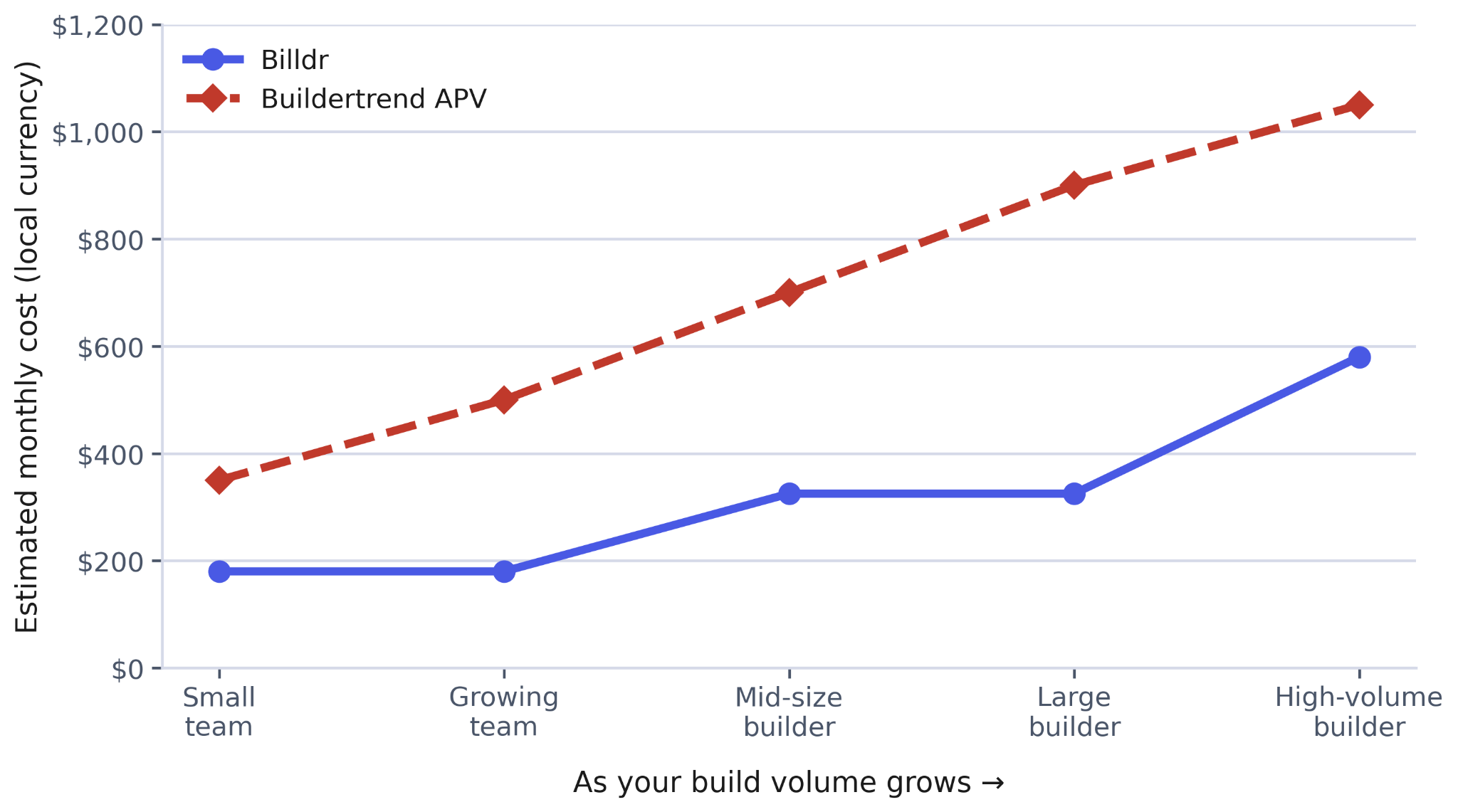
Estimated monthly cost as build volume grows. Billdr's flat, tiered pricing stays predictable. Buildertrend's Annual Project Volume model rises with your business.
| Billdr | Buildertrend, post-migration | |
|---|---|---|
| Pricing model | Flat, tiered by organizational scale | Annual Project Volume, scales with build volume |
| Entry price | From $180/mo (local currency) | ~Mid-$300s to $1,000+ USD/mo (est.) |
| Cost as you grow | Predictable, tier-based | Increases with your project volume |
| Best fit by size | Consistent at any size | Can favor very small shops; rises for high-growth ones |
| AI team included | Yes: Bob, Bruno, Billie | No AI team |
Billdr bills natively in the customer's local currency: CAD in Canada, USD in the U.S. Buildertrend bills in USD. Predictable pricing isn't automatically the better deal for every business: a very small shop with modest, steady build volume may find Buildertrend's APV model comes in lower than a flat-rate platform. The trade-off shows up for businesses that are scaling quickly, where APV's cost climbs alongside revenue. Get an actual quote from Buildertrend directly rather than relying on published estimates, including the ones in this article.
How Steep Is the Learning Curve?
Price is only part of the switching cost. How fast your team can actually get comfortable in the new platform matters just as much, especially mid-migration, when you can't afford weeks of lost productivity on active jobs.
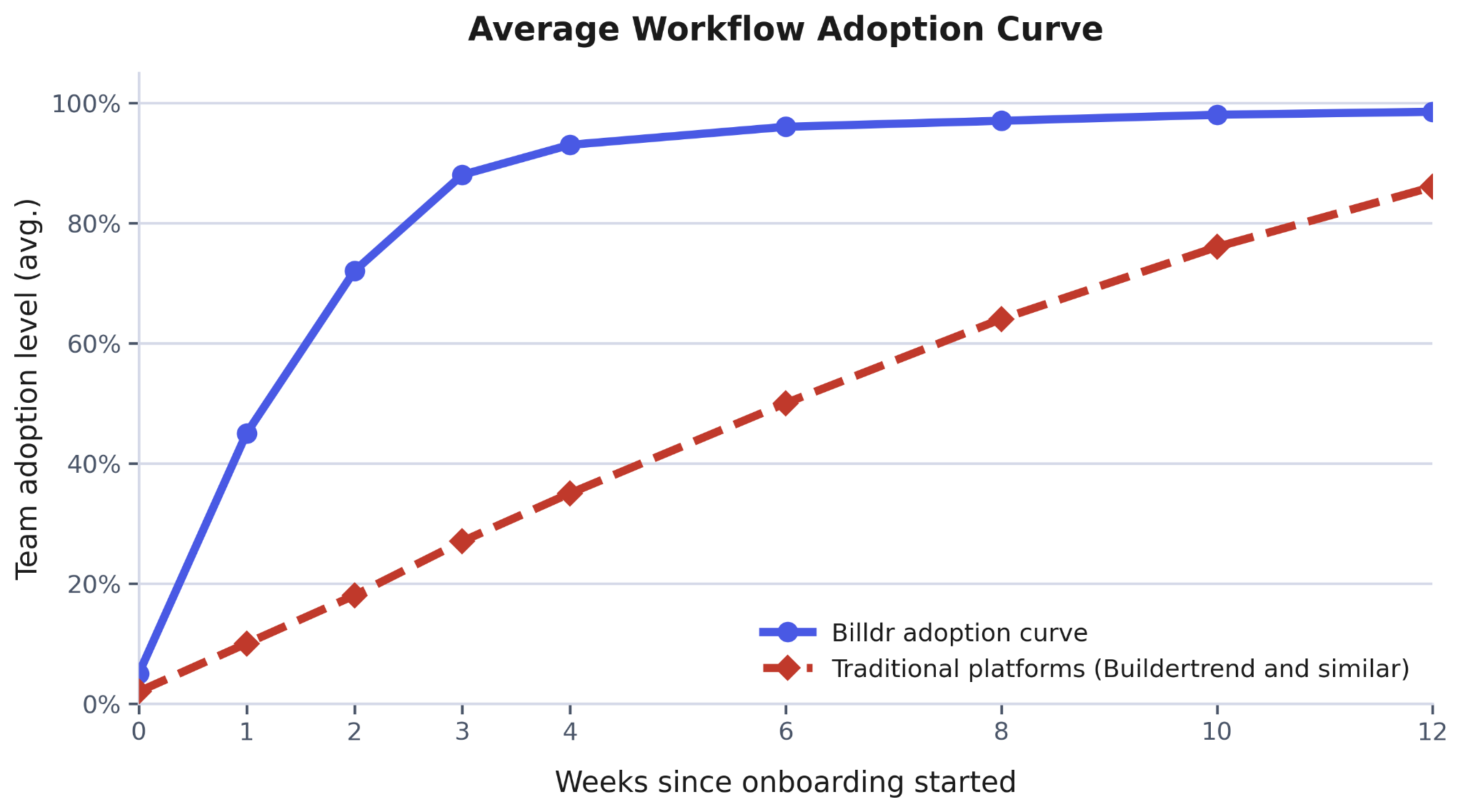
Average workflow adoption over the first 12 weeks. Billdr GCs typically reach full adoption faster than what's typical for traditional enterprise construction platforms.
This reflects the average time it takes GCs to adopt Billdr into their workflow, based on what we see across our own customer base. Individual results vary: some teams move faster, some take longer, depending on team size and how much of their existing process needs to change. The comparison line for traditional platforms is a directional estimate based on typical enterprise onboarding and setup timelines, not a formal side-by-side timed study.
What About Migrating Your Data?
Switching software after years on one platform is rarely about the new tool itself. It's about the move: the historical project data, the templates, the retraining, the fear of losing something mid-project.
Regardless of which platform you move to, CoConstruct's own migration terms keep your historical project data viewable for reference. That part isn't in question either way. Here's what's generally worth expecting when you plan the move itself:
Typically exports cleanly: your client list, cost catalog, and vendor contacts.
Usually needs rebuilding: project templates and in-progress budgets, since these tend to be structured differently across platforms.
Realistic timeline: plan for a focused week or two to inventory your data and get the core of a new account set up, running in parallel with active CoConstruct projects rather than a hard cutover.
Ask directly: whatever platform you're considering, get a specific answer on what transfers automatically versus what your team will need to rebuild by hand.
If you're considering Billdr instead of the default Buildertrend path, reach out through billdr.ai to get specifics on your own data before deciding.
Who Should Still Choose Buildertrend
Buildertrend is a mature, full-featured platform, and for a meaningful share of CoConstruct users, staying inside the migration path CoConstruct has already built will be the right call. If your business has grown to a scale where Buildertrend's broader enterprise feature set and established market position matter more to you than pricing predictability, the default path is a reasonable one. If your build volume is small and steady, APV pricing may genuinely cost less than a flat-rate alternative. And if your team has limited appetite for evaluating a new vendor relationship on top of a forced migration, staying within the path CoConstruct built removes one variable at an already busy time.
The point here isn't that Buildertrend is the wrong choice. It's that CoConstruct users currently have one path handed to them by default, and it's worth knowing what the alternatives look like before deciding it's the only one.
What to Do This Week
Export and inventory your CoConstruct data: client list, cost catalog, templates, and active projects.
Request an actual Buildertrend APV quote for your business, rather than relying on published estimates.
If you want to compare, book a Billdr demo at billdr.ai and ask specifically about migrating from CoConstruct.
Whichever direction you lean, confirm your timeline against the April 1, 2027 and June 30, 2027 dates so nothing is decided under last-minute pressure.
Transitioning off CoConstruct?
See how your active projects, cost catalogs, and client lists migrate over.
👉 Schedule a 1-on-1 Billdr demoYes. Per CoConstruct's own migration page, Buildertrend, which acquired CoConstruct in early 2021, has set a formal wind-down timeline. New projects can be added to CoConstruct only through March 31, 2027, and formal migrations to Buildertrend must begin by June 30, 2027. Existing project data remains viewable historically, but active development on CoConstruct as an independent product has stopped.
No. Buildertrend is the default path CoConstruct has built for you, and it is the option CoConstruct's own migration team will actively guide you through. But you are free to move your business to any construction management platform you choose, including Billdr.
APV is the pricing model Buildertrend is applying to migrated CoConstruct customers. Rather than a flat monthly fee, it scales with the dollar volume of the projects you build. Buildertrend does not publish its rates, but independent 2026 reviews put plans anywhere from the mid-$300s to over $1,000 per month, with the largest plans reportedly exceeding $50,000 per year. For a very small, steady-volume shop this can land lower than a flat-rate platform; for a fast-growing business it means cost rises alongside revenue. Get a specific quote directly from Buildertrend for your situation.
As of mid-2026, yes. Billdr's AI team includes Bob, which monitors every active project in real time and flags risks before they compound, and Bruno, which generates detailed estimates from your actual price book and past quotes. Billie, an AI lead-qualification assistant, is currently rolling out to early access. Neither CoConstruct nor Buildertrend currently offers a comparable integrated AI team, though this is a fast-moving space worth rechecking over time.
CoConstruct's own migration terms keep your historical project data viewable regardless of where you move active operations. If you choose Billdr instead of Buildertrend, reach out through billdr.ai to discuss what data can be brought over directly and what will need to be rebuilt.
Full Comparison Summary: Billdr vs Buildertrend (Post-Migration)
| Feature | Billdr | Buildertrend (APV) |
|---|---|---|
| Platform type | AI-native construction OS | Traditional enterprise construction platform |
| AI team | Bob, Bruno, Billie built in | No AI team |
| Pricing model | Flat, tiered by org scale | Scales with build volume (APV) |
| Entry price | From $180/mo (local currency) | ~Mid-$300s to $1,000+ USD/mo (est.) |
| Best fit by size | Consistent at any size | Can favor very small, steady-volume shops |
| AI estimating | Bruno, from your price book | Traditional estimating tools |
| AI project monitoring | Bob, real-time, flags risks | No AI monitoring |
| AI lead handling | Billie, early access rollout | No AI lead handling |
| Client portal | Full project dashboard | Client portal included |
| Daily logs | Built-in, auto client-shared | Included |
| Change orders | Included | Included |
| Currency | CAD (Canada) / USD (U.S.) | USD |
| Migration path from CoConstruct | Available on request via billdr.ai | Default, guided path |