

Becoming a licensed home builder in Arizona in 2026 is a journey of precision and professionalism. The Arizona Registrar of Contractors (ROC) maintains high standards to ensure that the state’s housing boom is built on a foundation of quality and financial stability. This guide walks you through the 2026 process, highlighting the mandatory B General Residential classification and how to navigate the state’s unique consumer protection funds.

Note: Requirements can evolve; always verify the latest on roc.az.gov.
Phase 1: Defining Your License & Business Entity
Arizona’s licensing system requires you to choose a specific "classification" that defines your legal scope of work. For the vast majority of residential builders, the B General Residential license is the gold standard.
1. Choosing the "B General Residential" Classification
This classification allows the licensee to construct and repair all or any part of a residential structure or appurtenance.
- Definition of "Residential": In Arizona, residential construction is specifically defined as work on houses, townhouses, condominiums, cooperative units, or apartment complexes of four units or less.
- The Specialty Subcontract Rule: This is a "supervisory" license. While you can frame and do general carpentry yourself, Arizona law mandates that work related to electrical, plumbing, air conditioning, swimming pools, spas, and water wells must be subcontracted to an appropriately licensed specialty contractor. You cannot perform these trades yourself under a "B" license unless you hold those specific specialty certifications.
- Dual Licenses (KB-1/KB-2): If you plan to build both residential homes and commercial structures (like a small office building), you may consider a KB-2 General Dual license. The KB-2 allows you to work on commercial projects under $2 million and any residential project.
2. Establishing Your Business Entity
You do not apply for a license as a person; you apply as a Business Entity.
- Arizona Corporation Commission (ACC): You must file Articles of Organization (for an LLC) or Articles of Incorporation (for a Corporation).
- Statutory Agent (Registered Agent): Every Arizona entity must designate a Statutory Agent. This is a person or company with a physical Arizona street address (no P.O. Boxes) who is available during normal business hours to receive legal documents on your behalf.
- Publication Requirement: Most new Arizona LLCs are required by law to publish a "Notice of Formation" in an approved newspaper for three consecutive weeks in the county where your business is located. Note: If your business is located in Maricopa or Pima County, this requirement is handled internally by the ACC, and you are generally exempt from manual publication.
Billdr Advantage: Administrative Speed
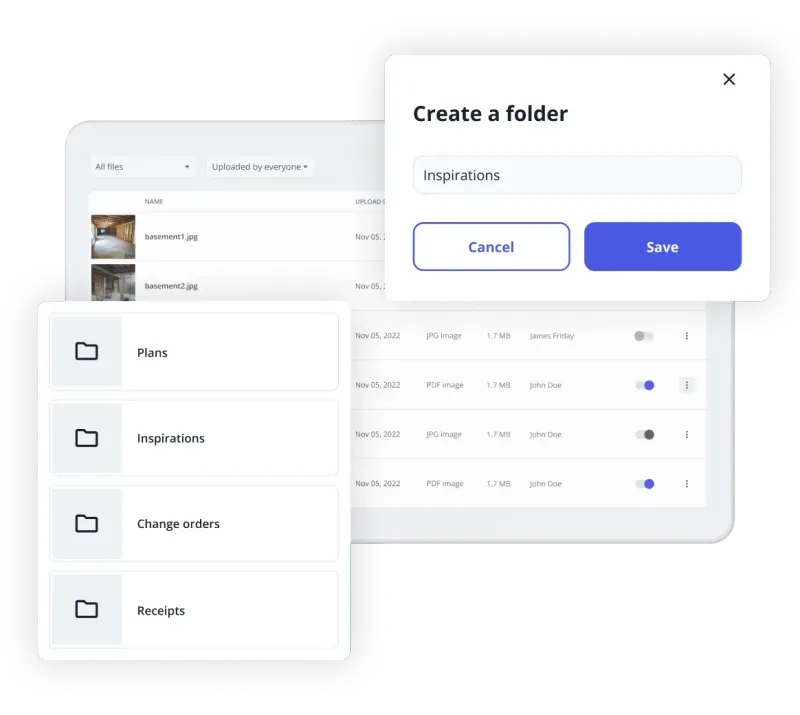
- The Entity Vault: Use the Document Hub to store your Articles of Organization and EIN. Having these ready ensures your bond and insurance are issued to the exact legal name, preventing ROC "Name Match" rejections.
Phase 2: Financial Responsibility & Consumer Protection
Arizona’s 2026 regulations emphasize that a builder’s license is a privilege tied to financial accountability. Phase 2 isn't just about paying fees; it's about establishing the "Financial Shield" that protects both your business and your future clients.
1. The Contractor’s Bond (2026 Tiers)
Every Arizona contractor must maintain a continuous surety bond. This is not insurance; it is a financial guarantee that you will follow the state’s building codes and fulfill your contractual obligations. If you fail to do so, the bond pays out to the harmed party, and the bonding company will come to you for reimbursement.
For a B-class General Residential Contractor, the bond amount is determined by your projected annual gross volume in Arizona:
Pro Tip: Your premium (the actual cost you pay) is typically 1–3% of the bond amount every two years, heavily influenced by the Qualifying Party's credit score. If your credit is below 600, expect premiums to climb toward 10%.
2. The Residential Recovery Fund
The Residential Recovery Fund is a unique "safety net" for Arizona homeowners. As a residential builder, you are required by law to provide consumer protection in one of two ways:
- Option A: The Recovery Fund (Most Common): You pay a $370 assessment during your initial application and $270 at every biennial renewal. This fund allows homeowners to claim up to $30,000 for damages caused by your work.
- Option B: The $200,000 Surety Bond: If you prefer not to participate in the fund, you must post an additional $200,000 surety bond or cash deposit. Due to the high cost of this bond, over 95% of Arizona builders choose Option A.
The 2026 "Clean Hands" Rule: Under the latest ROC protocols, if the fund pays out a claim on your behalf, your license is automatically suspended until you reimburse the fund in full plus interest.
3. Mandatory Workers' Compensation
While General Liability insurance is "highly recommended," Workers' Compensation is a legal mandate if you have employees.
- The "Owner-Officer" Trap: In Arizona, even if you are the only person in your LLC, you are technically an employee. You must either carry a policy for yourself or file a specific Waiver of Workers' Compensation with the ROC to prove you are exempt.
Billdr Advantage: Financial Safeguards
In a state where your license can be suspended over a $30,000 Recovery Fund claim, financial clarity is your best defense.
- Bond & Insurance Tracker: Upload your Surety Bond and Workers' Comp COI (Certificate of Insurance) to the Document Hub.
Phase 3: Experience & The Qualifying Party
In Arizona, the Qualifying Party (QP) is the "knowledge anchor" of the company. A company can have multiple owners, but it must have at least one QP who possesses the technical and legal expertise to oversee all construction operations.
1. The 4-Year Rule (2026 Verification Standards)
The Arizona Registrar of Contractors (ROC) requires the QP to demonstrate a minimum of four years of practical, verifiable experience in the "B" classification.
- The 10-Year Lookback: At least two of those four years must have occurred within the last 10 years.
- Technical Training Substitution: You can substitute up to two years of the requirement with a degree in construction management, architecture, or engineering from an accredited university.
2. Level of Skill: Proving Supervisory "Muscle"
The ROC doesn't just want to see that you were on a job site; they want proof of Journeyman-level or higher responsibility.
- Accepted Roles: Foreman, supervisor, superintendent, or licensed contractor in another state.
- The Paper Trail: Every month of experience must be documented via Work Experience Forms signed by a supervisor, employer, or client who can verify your hands-on management. In 2026, the ROC has intensified audits on these forms, often cross-referencing them with social security records or tax filings.
3. 2026 Background & Fingerprint Protocols
Every person listed on the license application (including all owners and the QP) must undergo a comprehensive criminal background check.
- The "AccuSource" Process: Arizona utilizes AccuSourceHR for digital background screenings. Unlike previous years, results are now transmitted to the ROC in real-time, significantly speeding up the approval window.
- Fingerprint Clearance: While some applicants can complete the check entirely online, any individual with a "red flag" history may be required to submit a Fingerprint Clearance Card from the Arizona Department of Public Safety (DPS).
4. The Experience Waiver (2026 Update)
If the QP has served as a Qualifying Party for another Arizona license in the same classification within the last five years, the ROC may waive the work experience documentation. This is a major benefit for established builders spinning off new LLCs.
Billdr Advantage: Experience Tracking
Documentation is the #1 cause of license delays in Arizona. Billdr turns your daily work into an unshakeable legal record.
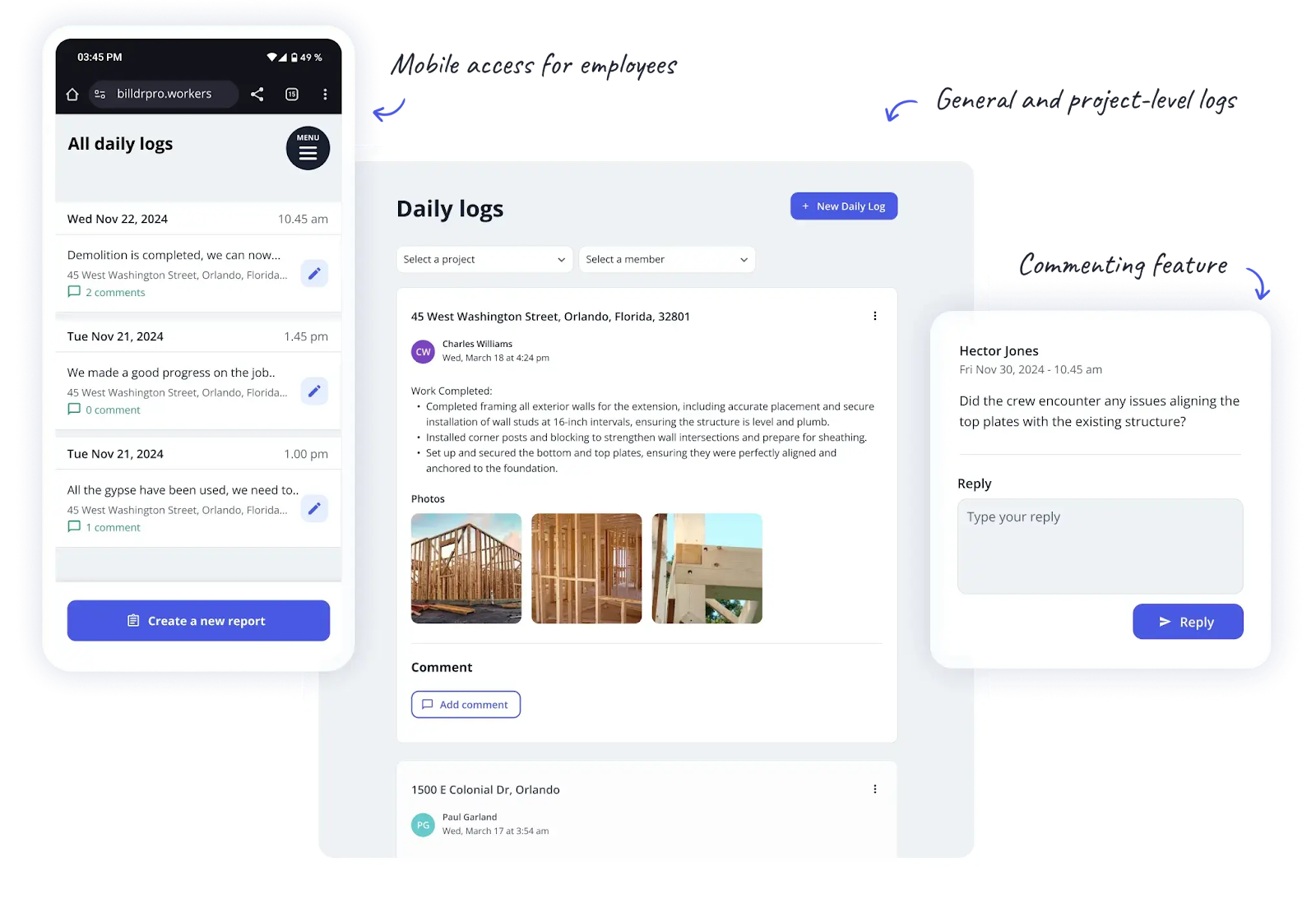
- Digital Site Logs: The ROC may request a "deep-dive" into specific projects to verify your supervisory role. Billdr's Daily Logs provide time-stamped, GPS-tagged photos and notes. If a reviewer asks, "How do we know you supervised the framing on the Scottsdale project?", you can pull up a 300-page project history in seconds.
Phase 4: The Examination & Post-License Compliance
Once the ROC verifies your four years of experience and clears your background check, you move into the final "Academic Phase." In 2026, Arizona has fully modernized this process, allowing for both virtual and in-person testing options.
1. The Two-Part Challenge
Every Qualifying Party (QP) must pass two distinct exams. While both are open-book, the strict time limits require you to know exactly where to find information in your reference manuals.
- Part 1: Statutes and Rules (SRE): This is a 50-question, computer-based training course and exam focused on Arizona's contracting laws.
- The 2026 Shift: The SRE is now exclusively hosted online through GMetrix. It functions as a "Training Course and Exam," meaning you must complete interactive modules before taking the test.
- Passing Score: 70%.
- Topics: Arizona Revised Statutes (Title 32, Chapter 10), Business Management, and Workmanship Standards.
- Part 2: Trade Exam (B General Residential): Administered by PSI Exams, this is a 100-question test designed to ensure you can safely oversee all residential systems.
- Scope: Sitework (17%), Concrete (17%), Carpentry (17%), Thermal Protection (12%), and Safety/OSHA (6%).
- Time Limit: 240 minutes (4 hours).
- Permitted References: You are allowed to bring physical, tabbed copies of the 2018 International Residential Code (IRC) and OSHA 29 CFR Part 1926.
2. Renewals & Compliance (The Biennial Cycle)
Maintaining your license is an active process. Arizona uses a biennial (two-year) cycle to ensure all builders remain in "Good Standing."
- Biennial Renewal: Every two years, you must submit a renewal via the ROC Online Customer Portal.
- 2026 Fees: For a General Residential (B) license, the renewal fee is $320, plus the mandatory $270 Residential Recovery Fund assessment (Total: $590).
- The "Good Standing" Check: Before the ROC approves your renewal, they verify that your LLC is still "Active" with the Arizona Corporation Commission and that your $9,000–$15,000 bond has not lapsed.
- Voluntary Continuing Education: While Arizona does not mandate CE hours for renewal, the ROC now hosts monthly Applicant Education Seminars and provides "Workmanship Standard" workshops.
- The Recovery Fund Benefit: Voluntary participation in these state-sponsored training sessions is highly recommended. In the event of a homeowner dispute, documented attendance in these courses can serve as evidence of your commitment to state-mandated workmanship standards.
Estimated 2026 Startup Costs
Excludes tools, insurance, and exam fees.
Official Sources & Resources
1. Arizona Registrar of Contractors (ROC) - The "Primary" Sources
- Applying for a License (The Roadmap): roc.az.gov/applying-for-a-license — This is the ultimate "proofread" source for the GC to verify the 4-year experience rule and the QP definition.
- The Workmanship Standards Manual: roc.az.gov/files/minimum_workmanship_standards.pdf — This is the document the GC is legally liable for. Including this proves you understand their long-term risk.
- ROC Fee Schedule: roc.az.gov/fees — Use this to verify the specific $870 total initial fee for a B-General license (Application + License + Recovery Fund).
2. Arizona Corporation Commission (ACC) - The 2026 Update
- The Arizona Business Center (ABC): arizonabusinesscenter.azcc.gov — Critical: As of January 12, 2026, this replaced "eCorp." Providing this specific new link proves your guide is more current than your competitors.
- ACC News (Portal Launch): azcc.gov/news — Verification of the new systems transition.
3. PSI Exams & GMetrix - The "Test" Sources
- B-General Candidate Information Bulletin (CIB): PSI Candidate Bulletin (Direct PDF) — This is where the GC verifies the "open-book" status and the specific 100-question trade exam breakdown.
- GMetrix (SRE Portal): gmetrix.com/SRE — The source for the Statutes and Rules Exam (SRE) modules.
4. Financial & Legislative Sources
- SB 1087 (The Recovery Fund Law): azleg.gov/legtext/57leg/1R/summary/S.1087RAGE.DOCX.htm — Proof for the GC that the biennial assessment was indeed lowered to $370/initial and $270/renewal.
- Surety Bond Agency Directory (SBA): sba.gov/surety-bond-agency-directory — A verified list of bonding agencies for GCs who may have credit challenges.
Disclaimer
This article provides general information and is not legal, financial, or licensing advice. All applicants should consult directly with the Arizona Registrar of Contractors (ROC) and relevant legal or financial professionals for the most current and specific requirements.
**While Billdr greatly assists in organizing project documentation, tracking financials, and managing compliance tasks, its use does not guarantee the issuance of an Arizona contractor's license. Obtaining a license ultimately depends on meeting all state-mandated experience, examination, and regulatory criteria.**