

Updated April 2026 – Always check cslb.ca.gov for the latest bulletins, as regulations are subject to frequent legislative updates.
Executive Summary
California remains one of the most highly regulated construction markets in the United States. In 2026, the transition to a Class B General Building Contractor requires navigating an enhanced Contractors State License Board (CSLB) verification process and the strict financial protections of the Private Works Change Order Fair Payment Act (SB 440). While the universal insurance mandate has shifted to 2028, 2026 serves as a critical preparation and enforcement ramp-up year for new firms.

Phase 1: The CSLB Class B License
Obtaining your Class B license is more than a registration; it is a professional certification that proves you possess the specific knowledge required to manage complex California construction projects.
1. Qualifying Experience (The 4-Year Rule)
The CSLB requires 4 years of journey-level experience within the last 10 years.
- Defining "Journey-Level": You must be a fully qualified worker who can perform the trade without supervision. Credit is also given for experience as a foreman, supervising employee, contractor, or even an owner-builder.
- The "Two-Trade" Rule: For a Class B license, your experience should demonstrate involvement in projects requiring at least two unrelated building trades (framing/rough carpentry plus others). Framing and carpentry alone do not satisfy the two-trade requirement.
- Education Credits: You can substitute up to 3 years maximum of experience with relevant education, evaluated case-by-case by the CSLB based on transcripts:
- High Credit: Degrees in Construction Management or Engineering typically offer the most substitution.
- Partial Credit: Degrees in Architecture, Business, or Economics may provide up to 2 years.
- Technical Credit: Relevant A.A. degrees or approved technical training.
- Note: At least 1 year of practical, on-site experience is always mandatory.
2. Enhanced Verification & Audits
As of 2026, the CSLB has implemented stricter verification protocols to ensure the integrity of experience claims.
- The 3% Audit: A random 3% of all applications undergo a comprehensive investigation. If flagged, you must provide supporting evidence such as tax returns (W-2s/1099s), building permits you pulled as an owner-builder, or copies of past contracts.
- Certifier Requirements: Your "Certifier" (the person signing off on your hours) must have firsthand knowledge of your work. This can be a fellow contractor, a foreman, an employer, or even a building inspector.
- Increased Scrutiny: CSLB investigators now cross-check reported experience dates with tax and employment records to verify that your claims align with official data.
3. The Two-Part Examination
Once your experience is approved, you are invited to take two proctored exams. In 2026, these are administered via PSI computer-based testing centers.
- Law & Business Exam: Focuses on California-specific regulations. Key topics include:
- Contracting Requirements: Proper contract language for private vs. public works.
- Financial Management: Bookkeeping, payroll taxes, and cash flow.
- Labor Laws: California's strict wage-and-hour laws and UI/SDI requirements.
- Class B Trade Exam: Focuses on safety, structural integrity, and code compliance. Key topics include:
- Site Preparation: Excavation, shoring, and drainage.
- Framing & Structural: Seismic requirements (California specific) and rough carpentry.
- Finish Trades: Mechanical, Electrical, and Plumbing (MEP) coordination.
The Billdr Advantage: Phase 1 Organization
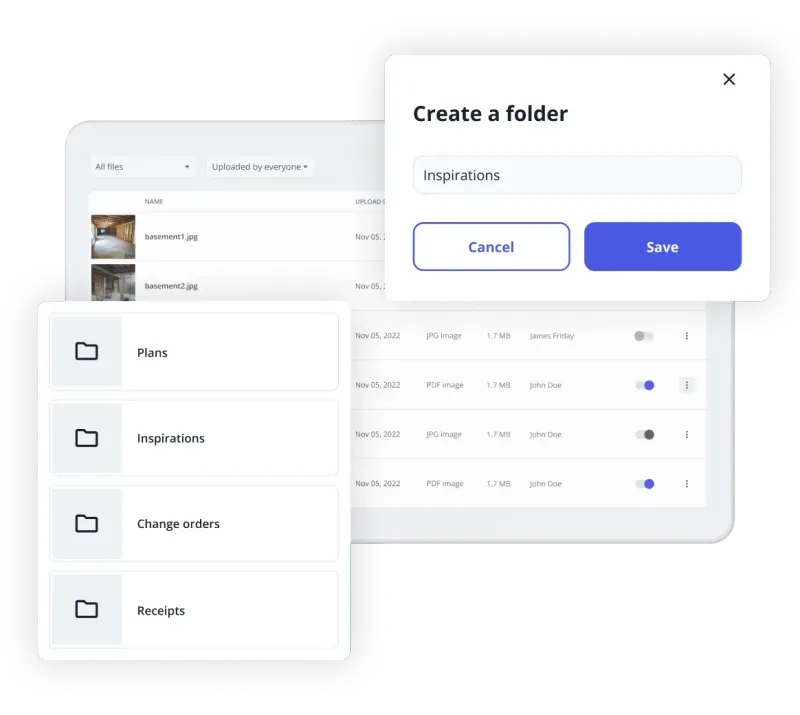
- Comprehensive Project Archiving: California's CSLB audits often happen years after a project is finished. Use Billdr's Files Management to store your W-2s, 1099s, and building permits within each project’s digital folder. By maintaining a structured history of your past work, you can easily pull the specific "Proof of Experience" documents needed to satisfy a CSLB investigator.
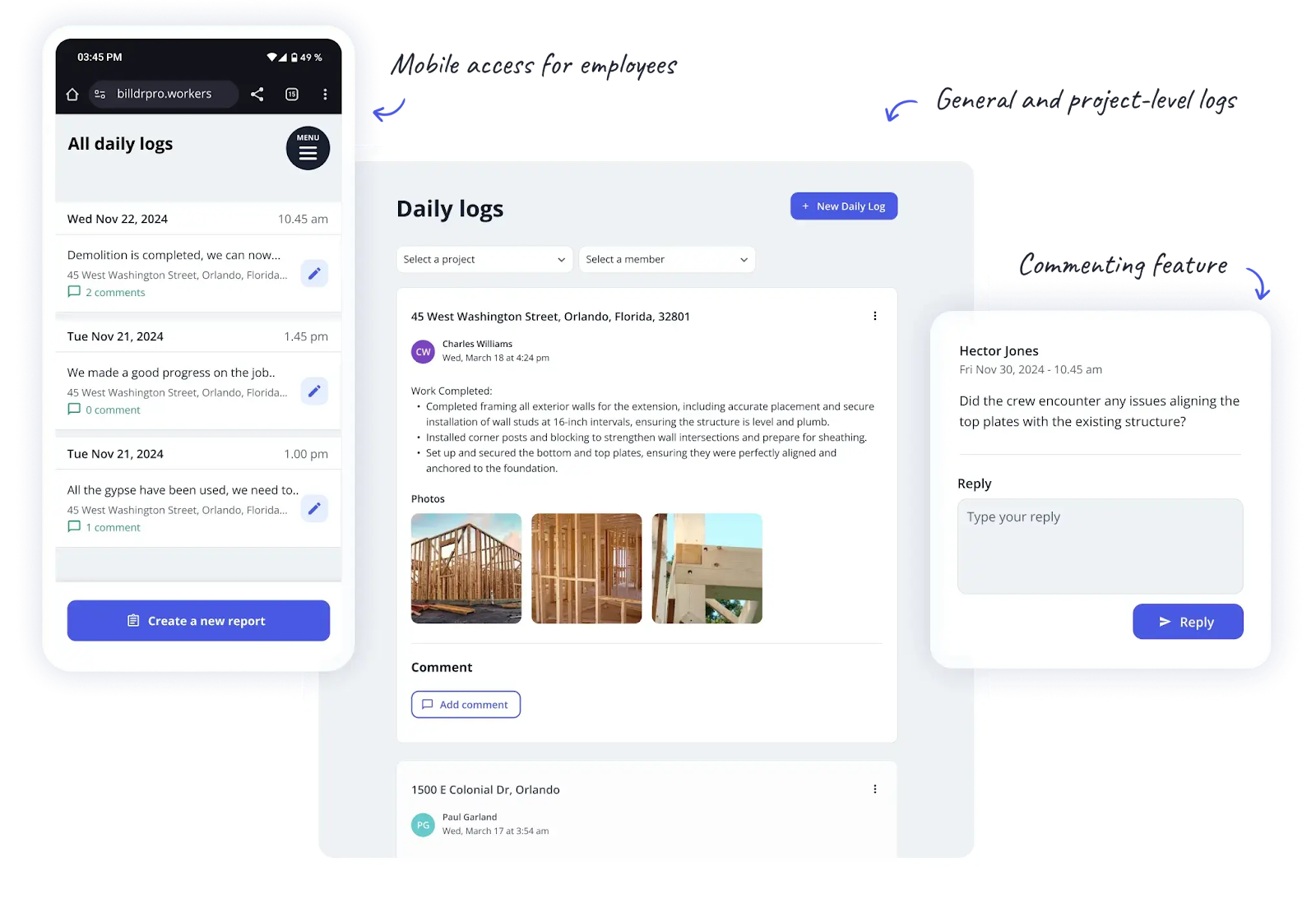
- RME Supervision Evidence: If you use a Responsible Managing Employee (RME) to qualify your license, the law requires "Direct Supervision and Control." Billdr's Daily Logs and Timesheets provide a perfect audit trail. By capturing timestamped site photos and digital logs of the RME’s instructions, you have defensible proof that your Qualifier is actively managing the site.
Phase 2: Bonding and Insurance Requirements
In California, your license is not "Active" until your bonds and insurance are verified and on file with the CSLB. In 2026, any lapse in these coverages results in an immediate, automated suspension of your license.
1. The $25,000 Contractor License Bond
This is a requirement for every license, regardless of business structure. It is not insurance for you; it is a surety bond that protects your clients and employees if you fail to follow state contracting laws.
- Purpose: It provides a fund that can be claimed against if you fail to pay subcontractors, fail to complete a project, or mismanage funds.
- Cost: Premiums typically range from $150 to $750 per year depending on your credit score and business history.
- Filing Process: Most bonds are now filed electronically by the surety company directly to the CSLB. While paper bonds are largely phased out for new applications, always confirm your surety has completed the digital transmission.
2. The $100,000 LLC Employee/Worker Bond
If you choose to operate your commercial firm as an LLC, California adds a significant extra layer of protection specifically for your labor force.
- Purpose: This bond is strictly for the payment of wages and fringe benefits for employees.
- Strict Liability: This is required in addition to the standard $25,000 bond, bringing an LLC's total bonding requirement to $125,000.
- Bonding Capacity: Due to the $100,000 value, surety companies may require a more thorough review of your financial statements or "Personal Indemnity" from LLC members.
3. Workers' Comp: The Enforcement Ramp-Up
While SB 1455 delayed the universal mandate for all contractors until January 1, 2028, 2026 is a critical preparation and enforcement year.
- Mandatory Trades: Regardless of staff size, if you hold the following classifications, you cannot file a Workers' Comp exemption in 2026:
- C-8 (Concrete), C-20 (HVAC), C-22 (Asbestos), C-39 (Roofing), and D-49 (Tree Service).
- Increased Scrutiny: If you file a Workers' Comp exemption as a Class B contractor, the CSLB may cross-reference your status against active building permits. If a project's scope clearly requires multiple workers, it may trigger an audit or request for payroll documentation.
4. Commercial General Liability (CGL)
Although the state CSLB doesn't mandate CGL for your license, the commercial market makes it a functional requirement for doing business.
- Project Specifics: For commercial work (offices, retail, industrial), you will rarely find a client or landlord who will allow you on-site without a $1,000,000 per occurrence / $2,000,000 aggregate policy.
- Additional Insured: Be prepared for owners to demand "Additional Insured" endorsements on a primary and non-contributory basis, along with waivers of subrogation.
The Billdr Advantage: Compliance Readiness
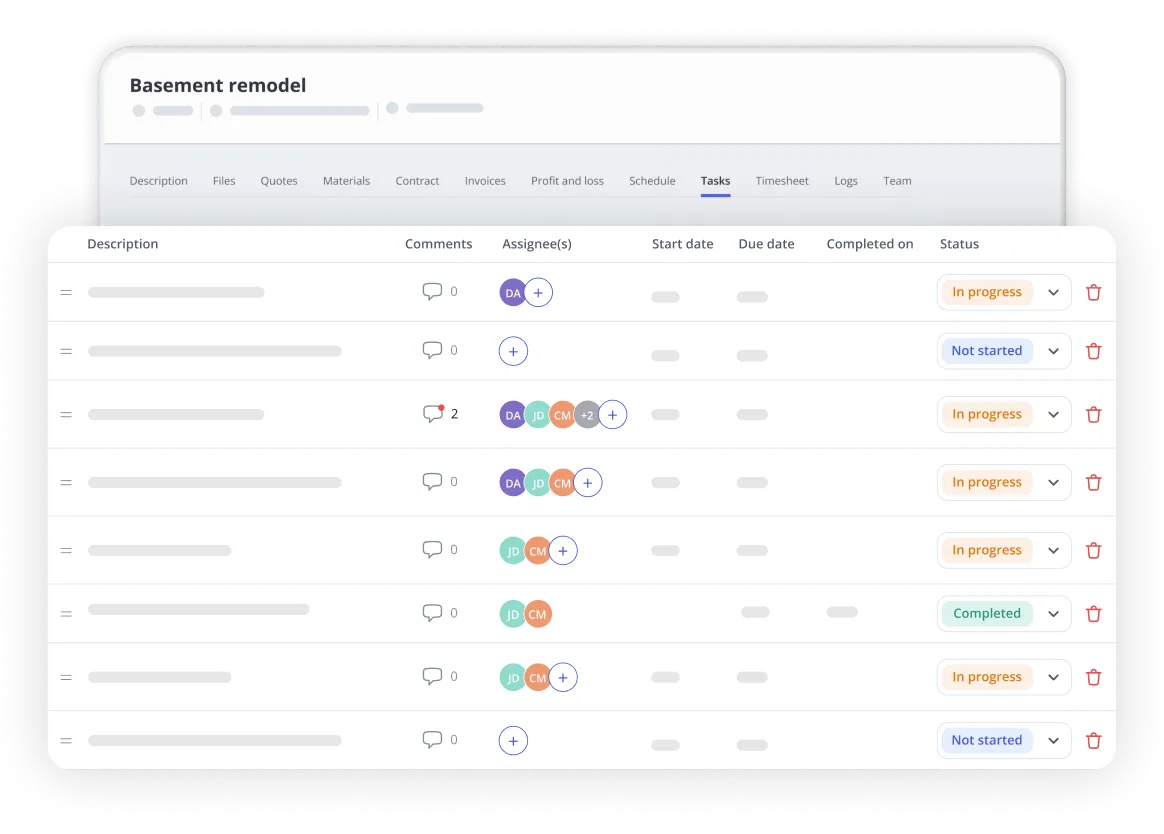
- Proactive Renewal Tracking: A license suspension due to a bond lapse can take weeks to resolve with the CSLB. Use Billdr's Task Management to set custom reminders 60 days before your License Bond or LLC Bond expires. By assigning these tasks to your office team, you ensure renewals are filed long before the CSLB's automated suspension triggers.
Phase 3: Business Infrastructure & Scope of License
While the CSLB grants you the "right to work," local municipalities control the "right to build." Mastering this phase is the difference between a project that starts on time and one that sits in a long permitting queue.
1. The "Journeyman Trap": Mastering Your Scope
The CSLB Class B license is not a "license to do everything." In 2026, California continues to enforce strict civil penalties for work performed outside of your legal classification.
- The Framing Core: A Class B contractor can take a prime contract (directly with an owner) for projects consisting solely of framing or rough carpentry.
- The Two-Trade Rule: For any other prime contract, the project must involve at least two unrelated building trades other than framing or carpentry. Note that framing and carpentry cannot be counted as one of the "two unrelated trades" to satisfy this requirement.
- The Subcontracting Restriction: A Class B contractor cannot take a subcontract (from another GC) for a single specialty trade (e.g., electrical only) unless the overall project qualifies under the multi-trade rule or the contractor also holds that specific specialty "C" license.
2. Municipal Hubs: Local Registration
In 2026, California’s major cities require a "Business Tax Registration Certificate" (BTRC) or local business license before they will issue a commercial permit.
- Los Angeles (LADBS): You must maintain a valid BTRC to remain in good standing. Local tax renewal deadlines vary, but missing them can lead to your access to the LADBS e-permit system being throttled or blocked.
- San Francisco (DBI): For all permits filed in 2026, you must comply with the 2025 San Francisco Building Code Amendments. There is no grace period for reverting to 2022 standards.
- Zoning Verification: For commercial GCs, "Site Plan Approval" is now often a mandatory pre-step. In many jurisdictions, you must obtain a Zoning Verification Letter before the Building Department will formally accept your plans.
3. The Digital Mandate (SB 1455)
As of 2026, the CSLB has transitioned almost entirely away from paper-based administration.
- Mandatory Email: Per SB 1455, all licensees must maintain a current email on file with the board. This is now the primary method for receiving legal Stop Orders, renewal reminders, and critical legislative updates.
- Electronic Plan Review (EPR): Most major commercial jurisdictions now require 100% digital submissions. This includes strict 2026 standards for "layered PDFs" and verified digital architect stamps that allow for real-time municipal comments and revisions.
The Billdr Advantage: Phase 3 Management
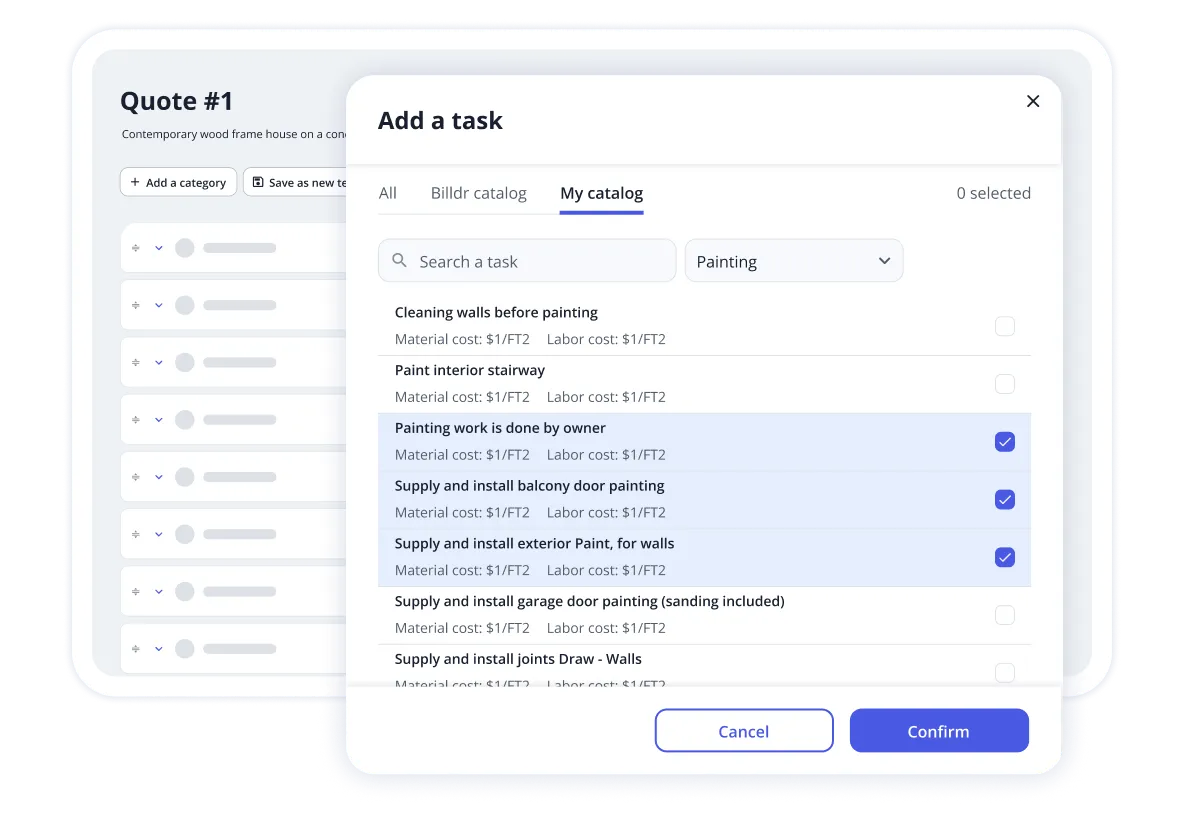
- Multi-Trade Quoting Accuracy: Avoiding the "Journeyman Trap" requires clear bidding. Use Billdr's Template Engine and extensive Cost Catalog to build comprehensive quotes that naturally encompass the required "two unrelated trades." By using professional templates that categorize work into distinct trade buckets (e.g., Framing, Plumbing, Electrical), you ensure your prime contracts are structurally compliant with CSLB Class B scope requirements from day one.
Phase 4: The 2026 Regulatory Environment (SB 440)
Before 2026, many California contractors were forced to perform extra work while waiting months for payment approval. SB 440 (the Private Works Change Order Fair Payment Act) provides a mandatory, non-waivable framework for contracts entered into on or after January 1, 2026, ensuring you get paid for extra work.
1. The Claims and Dispute Resolution Process
The law establishes a strict timeline that triggers as soon as a written claim for extra work is submitted via certified or registered mail.
- The 30-Day Response: Upon receipt of a claim, the owner has 30 days to provide a written statement identifying which portions of the claim are "undisputed" and which are "disputed."
- Informal Conference: If the owner fails to respond or you dispute their findings, you may demand an informal "meet and confer" conference, which the owner must provide within 30 days of the request.
- Non-Binding Mediation: If the dispute remains unresolved after the conference, the parties proceed to mediation. While not an "automatic" stage for every claim, it is the required path for unresolved disputes before further legal action.
2. The 60-Day Payment Trigger
SB 440's primary leverage lies in its strict deadlines for paying out undisputed sums to keep project cash flow moving.
- Mandatory Payment: Any amount the owner identifies as "undisputed" in their initial 30-day response must be paid within 60 days of that response.
- Interest Penalties: If the owner fails to pay the undisputed portion within that 60-day window, they are liable for a 2% monthly interest penalty (24% APR). This high statutory penalty serves as a massive incentive for prompt commercial payments.
3. Enhanced Stop-Work Rights
The "nuclear option" for GCs has been strengthened. You now have clear statutory authority to suspend work if payment obligations aren't met.
- Statutory Authority: If an owner fails to pay an undisputed amount or meet the response timelines, you may suspend performance without being in breach of contract.
- The Notice Cycle: You must first provide a 30-day notice that payment is due. If payment is still not received, you must issue a final 10-day notice of intent to suspend work (a total 40-day cycle).
- Liability Protections: Once work is suspended under this statute, the contractor is not liable for any liquidated damages or delays resulting from the stoppage.
4. SB 61: The 5% Retention Cap
Accompanying SB 440 is SB 61, which fundamentally changes project liquidity for private works contracts signed after January 1, 2026.
- The New Cap: For most private commercial projects, retention is now strictly capped at 5% (down from the traditional 10%).
- Flow-Down Provision: This 5% cap is mandatory and must flow down through all tiers of the project, ensuring that subcontractors and suppliers receive their held funds significantly faster than in previous years.
The Billdr Advantage: California 2026 Readiness
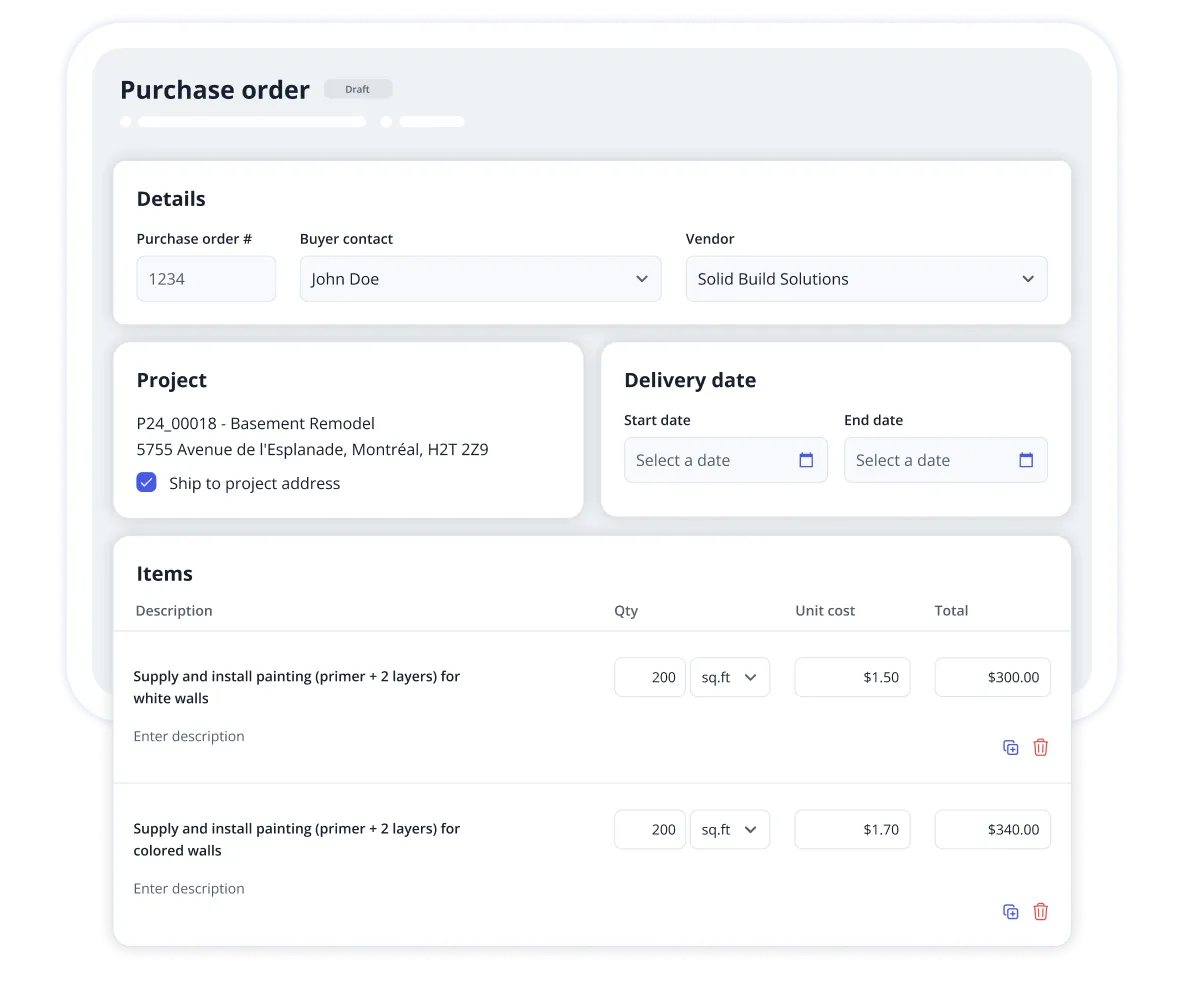
- Sub-to-Owner Claim Coordination: Avoid personal liability for subcontractor delays. Use Billdr's Purchase Order and Files Management to centralize all incoming claims from your sub-trades. Having these documents organized by project allows you to review and "pass through" subcontractor claims to the owner within the legal 30-day window, protecting your firm’s standing under SB 440.
2026 California Startup Costs (Estimated)
Building for the Future
Launching a commercial construction firm in California in 2026 is an exercise in meticulous administrative preparation. With the SB 440 payment reforms providing more leverage than ever before and the CSLB increasing its digital oversight, the "pen" has become as important as the "hammer." By standardizing your documentation early and treating your license, bonds, and insurance as a dynamic business asset rather than a one-time hurdle, you position your firm to thrive in California’s high-stakes commercial market. In this new era of "fair payment" and enhanced accountability, the contractors who master the back office will be the ones who lead the job site.
Official California Resources
1. Licensing & Regulatory Authority
- CSLB (Contractors State License Board)
- Purpose: The primary body for licensing, bonding, and trade regulation. Use this for initial applications, license status checks, and mandatory email registration.
- 2026 Highlight: Visit the New Laws Affecting Contractors page to stay current on the shifting Workers' Comp timelines and SB 1455 mandates.
- CSLB Experience Verification Guide
- Purpose: A detailed directory of exactly which documents (W-2s, 1099s, permits) the CSLB accepts during their enhanced 2026 audits.
- Resource: Download the Certification of Work Experience (Form 13A-11) for your certifiers to sign.
2. Labor, Safety & Insurance
- DIR (Department of Industrial Relations)
- Purpose: Manages workplace safety (Cal/OSHA), wage claims, and apprenticeship standards.
- 2026 Tool: Use the DIR Workers' Comp Coverage Search to verify subcontractor policies in real-time.
- Cal/OSHA Safety & Health Guidance
- Purpose: Essential for staying compliant with California’s strict heat illness prevention and wildfire smoke safety standards, which are heavily enforced in 2026.
3. Business & Legal Infrastructure
- California Secretary of State: bizfile Online
- Purpose: The portal for forming your LLC or Corporation. This is where you obtain the Entity Number required for your CSLB application.
- Official SB 440 Text (Private Works Change Order Fair Payment Act)
- Purpose: The "Legal Playbook" for 2026. Keep this bookmarked for your project managers to reference when an owner delays payment on extra work.
4. Study & Professional Development
- CSLB Examination Study Guides
- Purpose: Official breakdowns of what is on the Law & Business and Class B Trade exams, including recommended reference books and practice questions.
- 2026 California Contractors License Law & Reference Book
- Purpose: The "Bible" for California contractors. A new edition is released annually (April 2026 edition now available) and is the primary resource for the state licensing exam.
Disclaimer: Billdr is a project management tool and does not provide legal or licensing authority. California construction laws are subject to frequent change; always verify the latest requirements directly with the CSLB, DIR, and a qualified construction attorney or insurance professional.