
Updated April 2026 – Always verify current statutes at myfloridalicense.com as board rules and interest rates are subject to change.
Executive Summary
Florida’s commercial construction sector is a high-reward market governed by rigorous standards. To operate as a Certified General Contractor (CGC) in 2026, you must navigate the oversight of the Department of Business and Professional Regulation (DBPR) and the Construction Industry Licensing Board (CILB). This guide outlines the four-phase roadmap to licensing, from structural experience requirements to the 2026 "Fair Payment" interest rates.

Phase 1: Determining Your Licensing Authority
While local “Registered” licenses remain available for county-specific work, the Certified General Contractor (CGC) license is the standard choice for most commercial firms. It provides statewide authority to pull permits and perform work on any building type, regardless of height or size.
1. Choosing Your Path: Certified (CGC) vs. Registered
- Certified General Contractor (CGC): This license allows you to operate in all 67 Florida counties without additional local approvals. It is the preferred option for contractors planning high-rise, multi-county, or large-scale commercial projects, as it eliminates the need to prove competency to individual municipalities.
- Registered Contractor: This license is tied to a specific local jurisdiction (typically requiring a local certificate of competency). Work is limited to the counties or municipalities where you hold registration. It can be suitable for contractors focused on localized projects.
- Note on HB 735: Recent legislation (HB 735 and subsequent extensions) has preempted many local occupational licenses for trades not regulated at the state level. However, the core DBPR Registered Contractor pathway remains available for those who prefer or need to operate within specific jurisdictions.
2. The Governing Bodies: DBPR vs. CILB
Florida’s contractor licensing involves two key entities:
- DBPR (Department of Business and Professional Regulation): The administrative body that processes applications, collects fees, handles background checks, and issues the license.
- CILB (Construction Industry Licensing Board): The industry board that reviews experience documentation and makes final decisions on licensure. The CILB holds monthly meetings to consider applications.
2026 Insight: It is common for initial applications to receive deficiency letters requesting additional documentation or clarification. Staying organized and responding promptly helps avoid unnecessary delays.
3. Basic Eligibility & Background Check
- Age & Identification: Applicants must be at least 18 years old. A Social Security Number (SSN) is standard, but Florida accepts an Individual Taxpayer Identification Number (ITIN) for those without an SSN.
- Livescan Fingerprinting: A criminal background check via Livescan is required.
- Workflow: Submit your application first through the DBPR portal, then complete fingerprinting at a registered Livescan provider (such as IdentoGO). Use the correct ORI number provided by DBPR.
- Timing: Results typically reach the DBPR within 3–5 business days.
- Important: Coordinate both steps carefully so the fingerprint results properly link to your application and avoid processing delays.
The Billdr Advantage: Phase 1 Efficiency
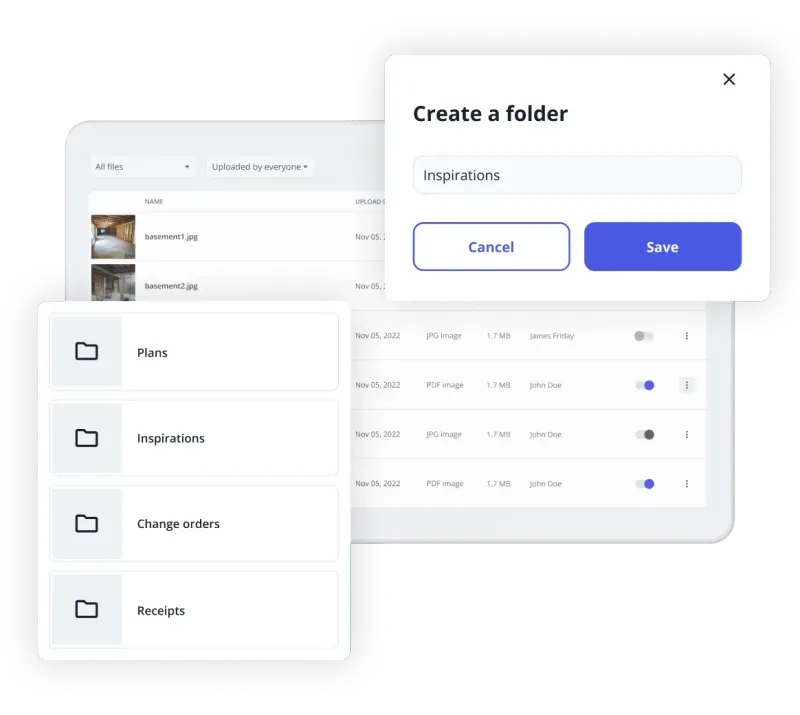
- Centralized Compliance Vault: Phase 1 requires managing critical legal documents like your Articles of Incorporation, ITIN/SSN records, and your Livescan receipt. Instead of losing these in your email or a physical folder, use Billdr's Document Management tool. Create a "Corporate Compliance" folder to store every piece of evidence the CILB might request during their review.
Phase 2: The Four Pillars of Qualification
To qualify for a Certified General Contractor (CGC) license, applicants must satisfy four core requirements: verifiable structural experience, financial responsibility, successful completion of the state examinations, and proof of required insurance.
1. Structural Field Experience
Florida requires four years of verifiable construction experience (or a combination of college credits and experience). For the CGC license, the CILB emphasizes structurally related commercial or high-rise experience.
- The 4-Story Rule & Ground-Up Mandate: You must demonstrate at least one year of experience on buildings four stories or taller. In addition, at least one year must be in new ground-up construction, specifically as a salaried employee or foreman, from initial site preparation through final completion.
- Trade Specifics: Proficiency must be shown in at least four of the following structurally related areas:
- Foundations/Slabs (>20,000 sq. ft.)
- Masonry walls
- Steel erection
- Elevated slabs
- Column erection
- Formwork for structural reinforced concrete
- Verification via Affidavits: Experience is documented through Affidavits of Experience signed by a licensed contractor (or other qualifying individual) with firsthand knowledge of your work performed under the supervision of a licensed contractor. Vague or incomplete affidavits may result in a request for an in-person appearance before the CILB.
- Substitutions:
- Military: Up to 3 years of active duty service can be substituted (DD-214 required).
- Education: An accredited 4-year degree in Construction Management or Engineering can substitute for up to 3 years; other degrees are reviewed case-by-case.
- Important Note: At least one year of supervisory field experience is always required, regardless of substitutions.
2. Financial Responsibility (The 660 Rule)
- FICO Score Threshold: A FICO-derived credit score of 660 or higher is the standard for demonstrating financial stability.
- The 14-Hour Remedy: If your score is below 660, you must successfully complete a Board-approved 14-hour Financial Responsibility Course covering lien laws, bookkeeping, and fiscal management.
- Bonding Option: Some applicants supplement or satisfy the requirement with a surety bond (amounts typically $10,000–$20,000 depending on whether the course is completed).
3. The Three-Part Examination
Registration is handled by Professional Testing, Inc., with computer-based testing administered via Pearson VUE. All sections are open-book.
- Business & Finance (~6.5 hours): Covers payroll taxes, insurance, financial management, and the Florida Prompt Payment Act.
- Contract Administration (~4.5 hours): Focuses on legal and administrative aspects of contracts, including lien laws and safety regulations.
- Project Management (~4.5 hours): Covers technical execution, blueprint reading, scheduling, and structural code compliance.
Note: A minimum score of 70% is required on each section.
4. Mandatory Insurance
Proof of insurance must be provided before the license can be activated:
- Commercial General Liability (CGL): State minimums are typically $300,000 public liability and $50,000 property damage. In practice, many commercial developers and owners require higher limits (commonly $1M/$2M).
- Workers’ Compensation:
- Required for any construction business with one or more employees.
- Officers or LLC members may file for an exemption, but proof of the exemption must be submitted to the DBPR within 30 days of licensure.
The Billdr Advantage: Phase 2 Documentation
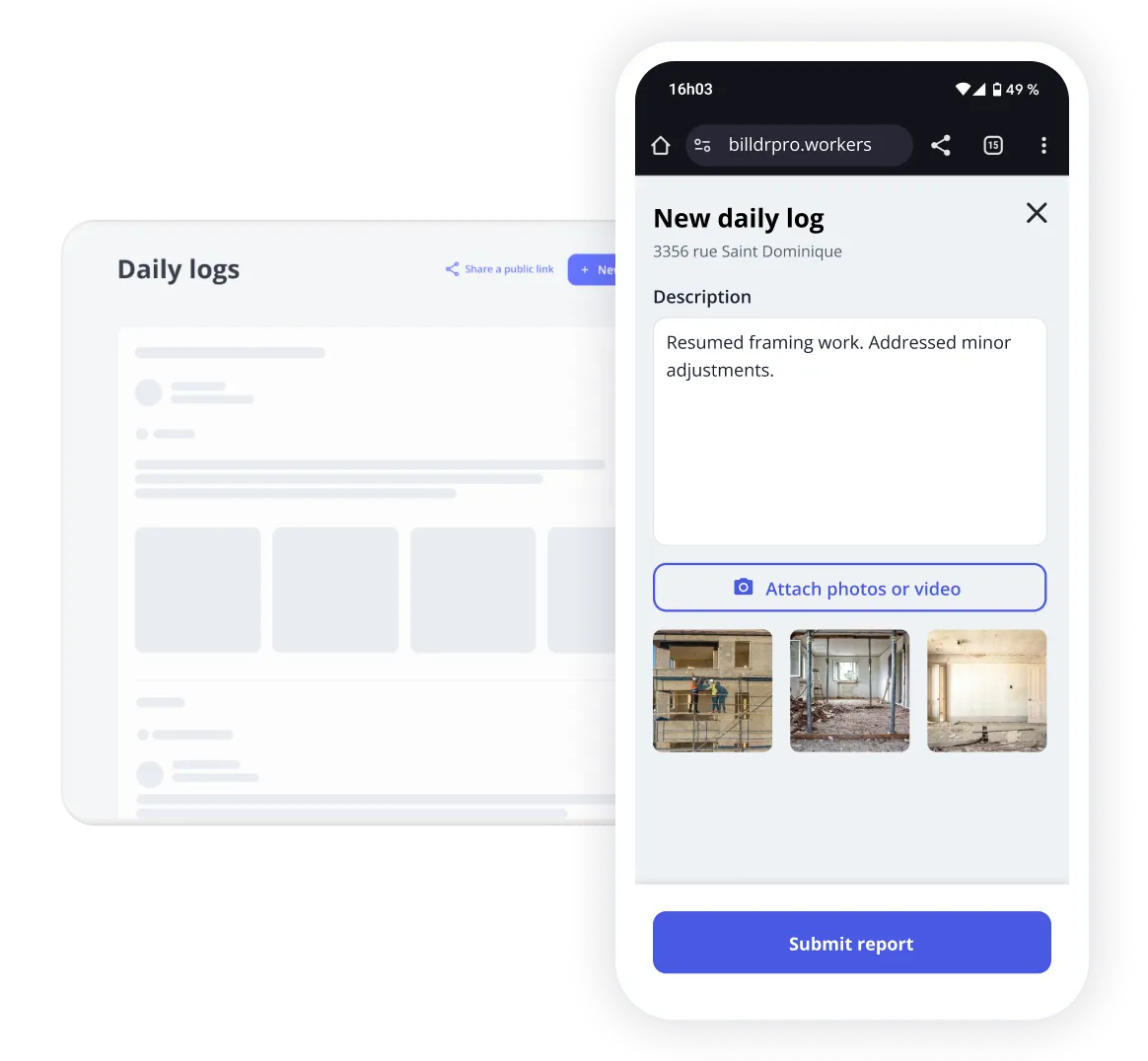
- Audit-Proof Affidavit Archive: Don't wait until the end of the year to collect experience data. Use Billdr's Daily Logs to archive photos of foundation pours, steel erection, and 4-story structural work. When it’s time to fill out your DBPR Experience Affidavits, you can pull exact dates and project scopes from your digital history to ensure your certifier is signing off on accurate, defensible data.
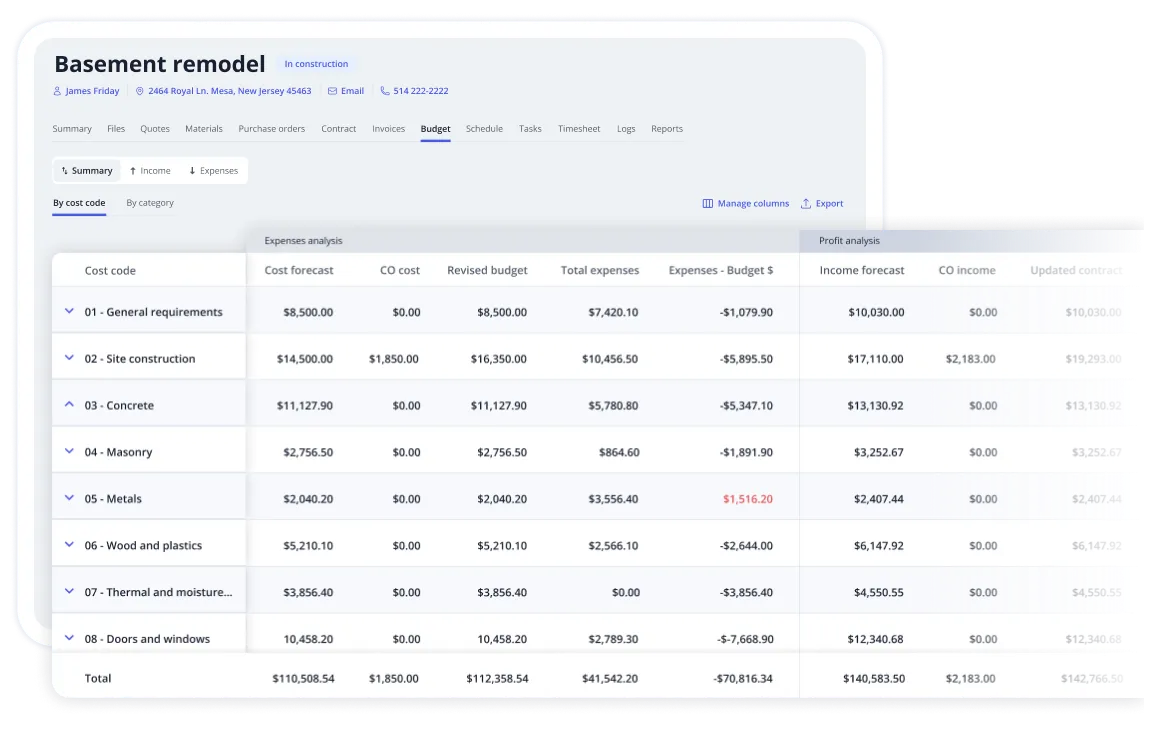
- Financial Oversight & The "660" Prep: If you’re working to improve your financial standing, use Billdr's Budgeting and Cost Tracking tools. Showing a bank or a surety company a professional, digital record of your project's cash flow can be the difference between getting a high-value bond and being denied.
Phase 3: The 2026 Regulatory Environment
In 2026, commercial general contractors in Florida must stay current with updates to the Florida Building Code, prompt payment protections, and new provisions that speed up permitting.
1. Florida Building Code: The 9th Edition Transition
Florida operates under one of the strictest building codes in the United States.
- Effective Date: The Ninth Edition (2026) Florida Building Code takes effect on December 31, 2026. Projects permitted before this date will continue under the Eighth Edition (2023).
- Key Expected Changes:
- Wind Load & Impact Resistance: Adoption of updated ASCE 7-22 standards, which refine wind load calculations and strengthen requirements for the building envelope in high-wind areas.
- Coastal Corrosion Protection: New mandates (expected in Section 1711) requiring corrosion-resistant fasteners and materials for structures located within 3,000 feet of a saltwater coastline.
- Energy Efficiency: Greater alignment with the 2024 International Energy Conservation Code (IECC), including stricter Solar Heat Gain Coefficients (SHGC) for commercial glazing and improved insulation requirements.
2. Financial Protections: Prompt Payment
Florida’s Prompt Payment Act provides important cash flow protections for contractors and subcontractors.
- Public Projects: Government agencies must pay proper invoices within statutory timelines. Late payments accrue interest at the applicable rate (approximately 4.125% in early 2026, or the rate set by F.S. 55.03 and related statutes).
- Private Projects: Under F.S. 715.12, owners are generally required to release payment within 14 days of receiving a proper invoice, unless the contract specifies otherwise.
- Key Protection: Interest on undisputed amounts accrues automatically. Contract provisions that attempt to waive these interest rights are generally unenforceable under Florida law.
3. SB 526: Private Providers for Plan Review and Inspections
To reduce delays in municipal permitting, SB 526 requires local agencies to offer fee reductions when contractors use qualified private providers.
- Mandatory Fee Reductions:
- At least 25% of the attributable portion when a private provider is used for partial plan review or building inspection services.
- At least 50% of the total permit fee when the private provider handles all required plan reviews and building inspections.
- Forfeiture Rule: If a local building department fails to apply the required reductions, it may forfeit its ability to collect any permit fees for that project.
The Billdr Advantage: Phase 3 Operations
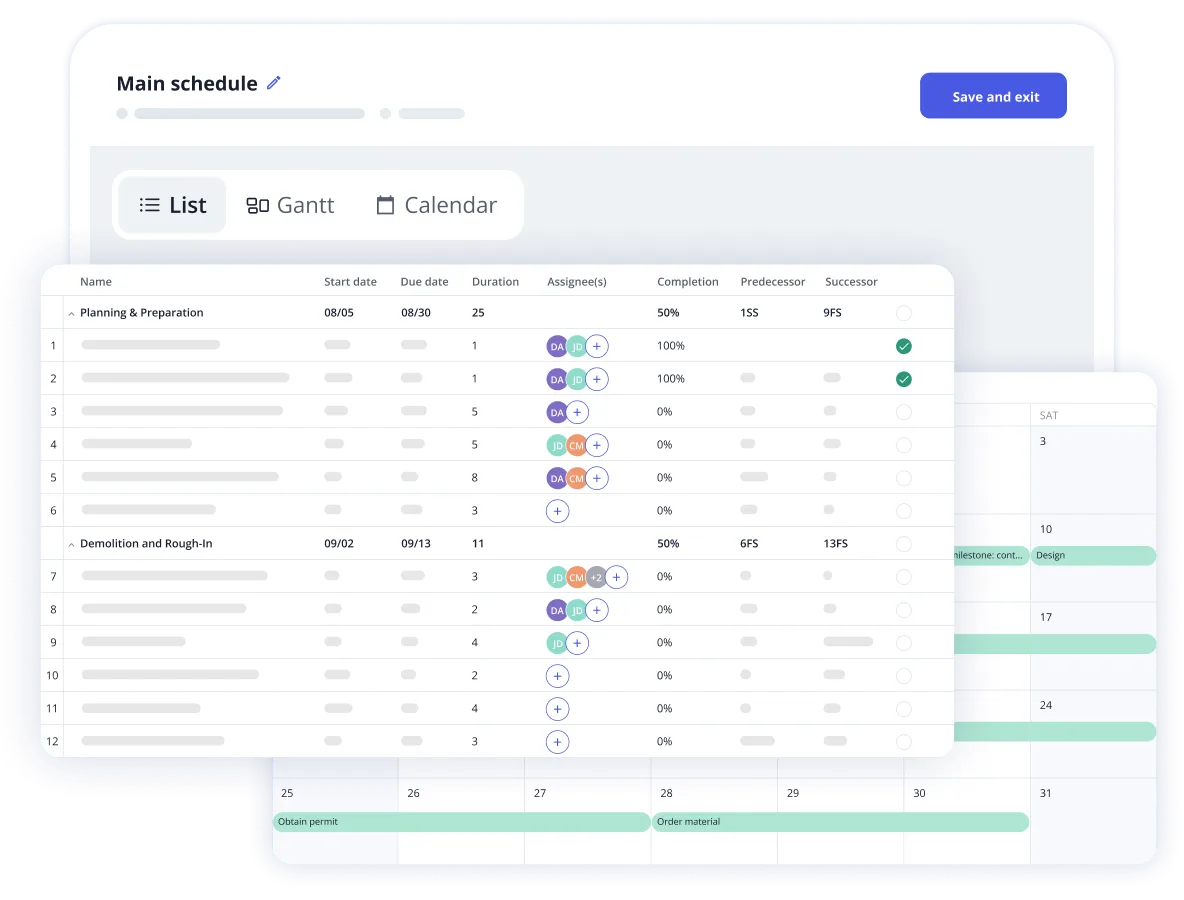
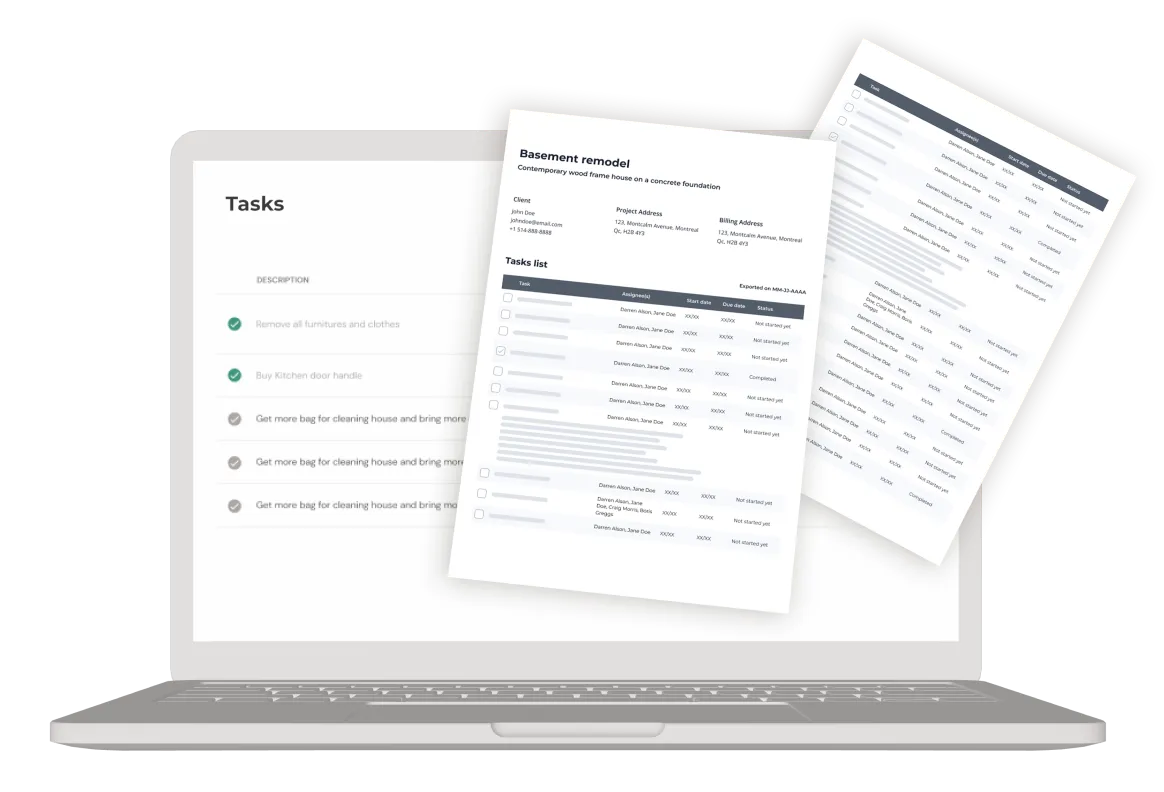
- Private Provider Coordinator: SB 526 requires strict coordination between your firm and the third-party inspector. Use Billdr's Schedule & Task Tool to sync inspection dates with your Private Provider. Since the city is no longer in charge of the timeline, you can use the app to compress your project schedule by 20–30%.
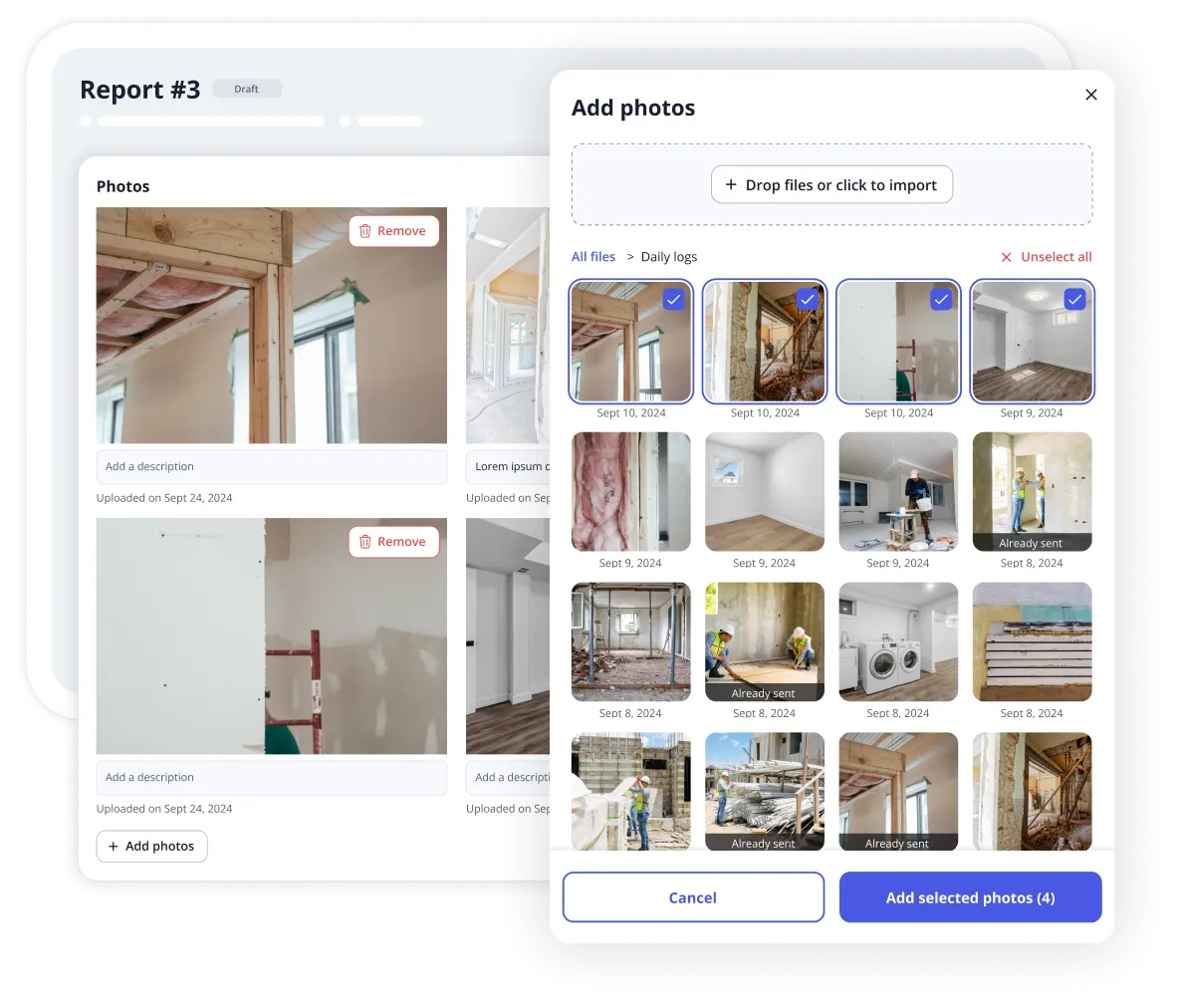
- Coastal Fastener Verification: For projects within the new 3,000-ft "Corrosion Zone," use the Photo & Daily Log feature to document the box labels of ASTM F1667 compliant nails and screws. This provides "instant proof" for inspectors that your materials meet the Ninth Edition's coastal mandates.
Phase 4: Tools for Maintaining Compliance
Once licensed, commercial general contractors in Florida must maintain strong documentation to protect against claims, pass inspections, defend liens, and support future license applications.
Specialized project management software, such as Billdr, can help by providing mobile-accessible tools for audit-ready records. Key areas where robust digital documentation proves especially valuable include:
1. HVHZ Technical Documentation (High-Velocity Hurricane Zones)
In Miami-Dade and Broward counties, HVHZ requirements are among the strictest in the world. Building officials may request a Notice of Acceptance (NOA) or Technical Evaluation Report (TER) for windows, doors, roofing, fasteners, or other components at any time.
- Best Practice: Maintain a centralized, cloud-based repository for each project containing current NOAs and site-specific engineering reports. Mobile access allows field supervisors to quickly retrieve exact specifications during inspections, reducing the risk of delays, re-inspection fees, or stop-work orders.
2. Lien Law & Notice to Owner (NTO) Tracking
Florida’s Construction Lien Law (Chapter 713) is complex and strictly enforced. A single missed deadline or incomplete paperwork can jeopardize your right to payment or expose you to double-payment claims.
- Best Practice: Implement a systematic workflow to log every incoming Notice to Owner (NTO) — subcontractors and suppliers generally must send one within 45 days of first furnishing labor or materials. Use digital tools to track NTOs and collect partial or final lien waivers via electronic signature before releasing progress payments. This creates a clear, verifiable chain of releases by final payment.
3. Ground-Up Audit Trail for Future Licensing
The CILB requires applicants to prove at least one year of supervisory experience in new ground-up construction (from foundation to completion).
- Best Practice: Maintain detailed, timestamped records of major construction milestones (foundation pours, structural masonry, steel erection, dry-in, etc.) along with personnel and supervisory logs. These records become extremely valuable when qualifying additional businesses, mentoring employees for their own licenses, or responding to CILB requests for supporting evidence beyond affidavits.
2026 Florida GC Startup Costs (Estimated)
Building for the Future
Successfully launching a commercial construction firm in Florida in 2026 requires more than technical skill—it demands a commitment to administrative excellence and regulatory agility. With the 9th Edition of the Florida Building Code on the horizon and the state’s continued move toward digital-first oversight through the DBPR, the contractors who thrive will be those who treat their back office with the same precision as their foundations. By leveraging tools to automate compliance, tracking SB 526 fee reductions, and maintaining an airtight audit trail for every project, you aren't just building structures; you are building a defensible, scalable, and highly professional commercial enterprise in one of the nation's most competitive markets.
Official Florida Resources & Technical Support
1. DBPR Portal (Department of Business and Professional Regulation)
- The Resource: www.myfloridalicense.com
- How to Use It: This is your primary administrative dashboard. You will use the "My Florida License" account to submit your initial application, pay your biennial renewal fees, and update your mandatory email address under the 2026 digital requirements.
- 2026 Feature: Use the "License Search" function to verify the standing of your subcontractors. In the commercial market, "active and current" status is a prerequisite for pulling permits and securing project insurance.
2. CGC Experience Portal (CILB Guidelines)
- The Resource: DBPR Construction Experience Requirements
- How to Use It: This sub-portal is the "Bible" for the structural experience requirement. It provides the specific Affidavit of Experience forms that your certifiers must sign.
- Critical Detail: Before you start your application, download the Work Experience Reference Guide. In 2026, the CILB is highly specific about the "4-story rule"; this portal provides the exact definitions of what qualifies as "structurally related" experience for a Commercial General Contractor.
3. Florida Building Commission (FBC)
- The Resource: www.floridabuilding.org
- How to Use It: This is the centralized hub for the Florida Building Code (FBC). You will use this to access the Product Approval System.
- 2026 Context: For commercial GCs, the Notice of Acceptance (NOA) search is vital. Before purchasing windows, doors, or roofing systems for a project in a High-Velocity Hurricane Zone (HVHZ), you must use this site to verify that the manufacturer’s product is approved for use in the current 8th or 9th Edition code cycles.
4. Division of Workers' Compensation
- The Resource: MyFloridaCFO - Workers' Comp
- How to Use It: Use the "Proof of Coverage Search" to verify that your business—and your subcontractors—are properly insured. Florida's 2026 enforcement of "Officer Exemptions" is strict; if you are an LLC member opting out of coverage, you must file your DWC-250 notice through this portal.
5. Florida Department of State (Sunbiz)
- The Resource: www.sunbiz.org
- How to Use It: Before you apply for your license, you must register your business entity (LLC or Corporation). The DBPR will cross-check your CILB application aga4inst your Sunbiz filing.
- Note: Your company name on Sunbiz must match your license application exactly. Even a missing "Inc." or "LLC" can cause the DBPR to reject your application in 2026.
Disclaimer: This guide is provided for informational purposes only. Laws and interest rates change frequently; always verify requirements with the DBPR, CILB, and a qualified legal or insurance professional before applying for licensure.